

Breaking Down Product-Market Fit: The Crucial Split Most B2B SaaS Companies Get Wrong
Splitting Product-Market Fit into Problem-Solution Fit and Go-to-Market Fit explains what causes PMF and how to achieve it systematically.


The Pattern of Stalled Sales
When sales just won’t take off, most B2B SaaS companies follow a predictable pattern. It plays out in early-stage startups and established corporations alike.
They train the sales team to sell based on value. Revamp the marketing message. Adjust pricing. Add the features prospects ask for.
Yet quarter after quarter, growth remains stubbornly slow.
They can’t pinpoint the root cause. Is it a sales execution problem? Is better marketing needed? Should they add more features to fulfil customers’ RFPs? Or is something more fundamental holding them back?
Often, the struggle stems from a misunderstanding of what drives product success in the first place.
The Ultimate Goal Every Product Leader Chases
“My most important goal within the next year is ensuring that our product has achieved Product-Market Fit.”
I heard this from a Chief Product Officer of a venture-backed B2B SaaS startup during my research interviewing 31 founders and product executives. It wasn’t surprising. Many product executives I have interviewed emphasise Product-Market Fit (PMF) as their critical milestone.
And they are right to obsess over it. Without PMF, even flawless execution can’t save you.
Another executive put it more directly: “The measure of whether you have Product-Market Fit is money.” Nothing else matters if you can’t generate sustainable revenue.
Yet despite universal agreement on its importance, PMF remains hard to reach. Studies estimate that between 60% and 95% of new software products fail to meet expectations. Billions in venture capital, countless engineering hours, and enormous market opportunities are squandered because companies can’t figure out how to achieve it.
What should concern every product leader is that even product teams that achieve some success often can’t explain exactly why. They either got lucky, or they have some intuitive understanding they can’t articulate. Neither is reliable or repeatable.
We can do better than treating PMF as a mysterious force that either does or doesn’t bless your product. We can break it down into components we can act on.
Why Common Definitions of Product-Market Fit Set You Up for Failure
How do the industry’s best-known thinkers define Product-Market Fit?
Marc Andreessen (2007), legendary VC and tech pioneer, says PMF means “being in a good market with a product that can satisfy that market.” He describes symptoms of missing PMF: customers aren’t getting value, usage isn’t growing, word of mouth isn’t spreading, sales cycles are too long, and deals don’t close.
Andy Rachleff, who originally coined the term in the mid-1990’s, says finding PMF means proving the value hypothesis, which identifies features, target customers, and business model to get customers to buy your product. He measures it by the contribution margin of a sales team exceeding the total cost of the sales team.
Sean Ellis (2009), who coined “growth hacking,” offers another specific metric: you have PMF when 40% of users would be “very disappointed” without your product.
Brant Cooper (2010) lists three criteria for PMF in his book about Steve Blank’s Customer Discovery process: the customer is willing to pay for the product, customer acquisition cost is less than the price customers pay, and the market is large enough to support the business.
Eric Ries (2011) describes PMF as “the moment when a startup finally finds a widespread set of customers that resonate with its product.”
These definitions all share the same limitation: they describe what PMF looks like after you’ve achieved it. They describe a destination without providing directions to get there.
Worse, focusing on these observable metrics and symptoms can send you in the wrong direction. When your product isn’t achieving PMF, what should you address? A lengthy sales cycle might point to ineffective sales approaches. Or it might indicate that your product doesn’t have the right features. Without understanding the underlying structure of PMF, you are a doctor prescribing painkillers without diagnosing the disease. The symptoms may temporarily subside, but the condition continues to worsen.
These definitions capture the signs of PMF, but we need a framework that explains what causes PMF and how to achieve it systematically. We need to break PMF into its components.
Behind Product-Market Fit: Untangling Two Distinct Types of “Fit”
The root problem with traditional PMF thinking is treating it as a single, monolithic milestone. But Product-Market Fit has two distinct components that require different approaches.
First, we need clarity on what a “market” means. A market should not be defined as a product category or an industry vertical, especially when creating something new and innovative. I define a market for B2B products as follows:
A market is a group of companies trying to solve the same specific business-related customer problem; and their employees who are involved in solving the problem.
With that definition in mind, I define Product-Market Fit as follows:
Product-Market Fit occurs when a company can regularly and consistently reach, sell to, deliver value for, and keep customers who are trying to solve the same problem (=target customers).
Product-Market Fit is easiest to reach by concentrating not on all possible target customers, but rather on the ideal customers: that segment of companies for whom solving their common problem delivers the most value.
Now we can split Product-Market Fit into its two separate components:
Problem-Solution Fit (PSF): Can a company consistently deliver value for and keep its ideal customers by solving their common problem?
Go-to-Market Fit (GTM Fit): Can a company regularly reach and sell to its ideal customers who have that same problem?
This distinction reshapes how you approach product development and growth.
Problem-Solution Fit means you’ve built a product that solves a real problem for your ideal customers so well that you can repeatedly deliver value for them and retain them. It concerns what your product does for your target customers.
Go-to-Market Fit means you can effectively price your product to capture value for your business, get your value proposition in front of your ideal prospects, and consistently close deals. It concerns how you sell what your product does for your target customers.
Problem-Solution Fit is about building the right product for the right customers. Go-to-Market Fit is about building the right way to sell it to the right customers.
You need both to succeed, but the challenges and solutions for each are different.
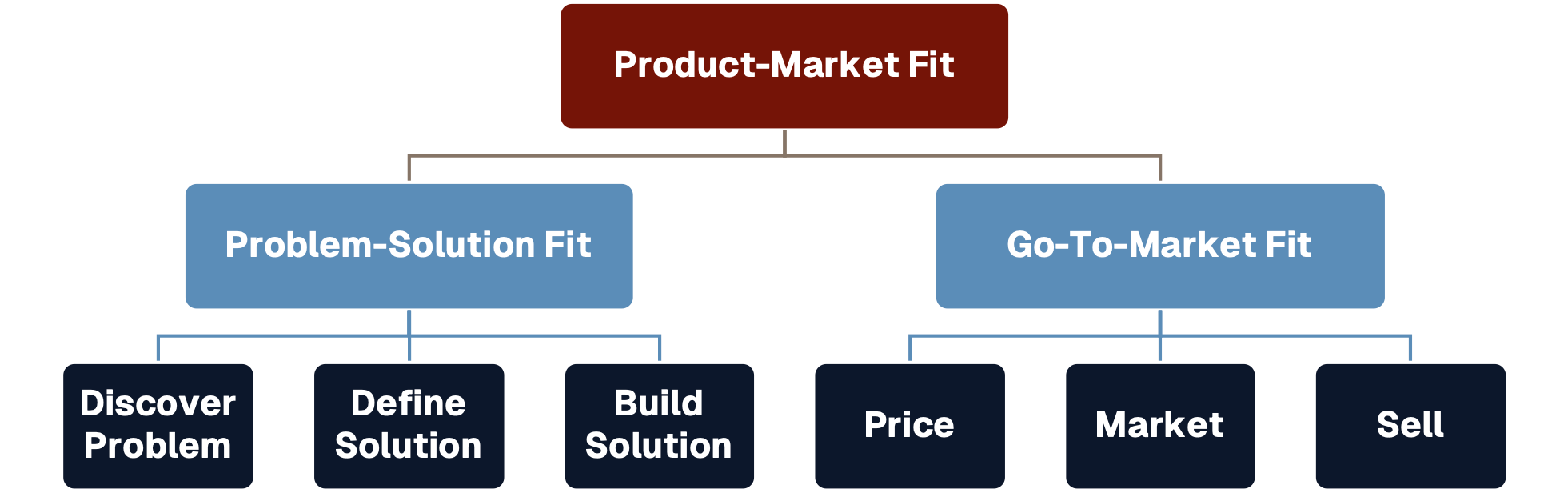
The common definitions of PMF in the previous section fail to distinguish between the two components. Some definitions match my definition of Problem-Solution Fit but omit aspects of Go-to-Market Fit, or vice versa. Yet the tech industry keeps discussing PMF as if it were a clear concept that everybody understands the same way.
This framework gives you more than a description of what PMF looks like. It gives you a map for achieving Product-Market Fit. When sales stall, you can diagnose whether you are facing a product problem or a go-to-market problem. When planning investments, you can target the real bottleneck instead of throwing resources at the wrong challenge.
The framework also reveals something about the path to PMF that many companies miss. Understanding the two types of “fit” is useful, but even more important is grasping how they interact.
The Fatal Flaw in Product Strategy That Kills Sales
Problem-Solution Fit and Go-to-Market Fit are not independent. Problem-Solution Fit sets a hard ceiling on your Go-to-Market potential.
How much value your product creates for your target customer determines how much you can charge for it. Your pricing strategy, a key element of Go-to-Market Fit, is constrained by your Problem-Solution Fit.
Your value proposition is a promise about the value your product delivers, which is directly determined by your Problem-Solution Fit. If your PSF is weak, no amount of marketing brilliance can build a compelling value proposition.
When your product solves critical problems for your ideal customers, sales cycles shorten naturally. As Rachleff puts it, “the customer pulls the product out of your hands”. When it doesn’t, even the best sales team struggles to close deals.
This explains why so many companies waste resources on the wrong remedy. They see slow sales and immediately try to improve their GTM strategy: better marketing, more sales training, different pricing models. But if the root cause is poor PSF, these investments can’t solve the real issue. They are repainting the walls of a building with a crumbling foundation.
One founder I interviewed understood why Problem-Solution Fit is so important for sales:1
“[Achieving Problem-Solution Fit is so important because] it would be much easier to sell the product. I would know that I’m selling something of value, something that really works. … If Problem-Solution Fit isn’t good, then selling is always a tremendous effort.”
Another product executive learned this the hard way:2
“We monitored how sales progressed after launch. The first half-year was bad, but we weren’t yet worried. However, when we had another poor half-year, we concluded that this wasn’t a sales problem nor a minor product challenge, but a real issue with Problem-Solution Fit.”
After a full year of poor sales, he realised that you can’t compensate for poor Problem-Solution Fit with great Go-to-Market execution.
With this understanding of how PSF and GTM Fit interact, you are better equipped to diagnose which kind of “fit” is holding your product back.
How to Diagnose Your Product-Market Fit Challenge
How do you know which type of “fit” you are struggling with? Here are some patterns I’ve observed across B2B SaaS companies:
Signs of poor Problem-Solution Fit:
Customers need extensive customisation to make the product work for them
Customer success requires substantial professional services
Customers use only a small portion of the product’s features
Different customers use very different features
Churn is high despite little competition
Product roadmap is driven by individual customer requests rather than customer problems identified as common ones
The product is very complex from the customers’ point of view
Support gets a large number of tickets
Customers complain the product is difficult to use
Signs of poor Go-to-Market Fit:
Difficulty articulating your value proposition
Marketing messages that don’t resonate with customers
Long sales cycles
Inconsistent sales performance across similar prospects
High customer satisfaction but slow sales
These symptoms require careful interpretation because many apparent Go-to-Market problems originate from poor Problem-Solution Fit. Take long sales cycles, which look like an issue with your GTM model. And sometimes they are, like with this AI-based product. The CPO of this Enterprise SaaS business admitted:
“Our pricing and packaging was wrong, to put it bluntly. We had what we thought was a good idea, that the pricing would be based directly on the value delivered to the customer. The model predicted [X] and the customer paid per successful [outcome]. It was a very elegant and nice idea, but it was quite complex. And then it wasn’t predictable.”
Then they changed their pricing model to a pure subscription fee that wasn’t volume-based, and somewhat surprisingly it worked. The CPO explained:
“It sounds foolish. Why wouldn’t a customer want to pay only for the value created? But ultimately, enterprise customers valued predictability more. They wanted to know how much this would cost them. It just wasn’t a very successful launch. The product itself worked well.”
Their Problem-Solution Fit was good; lack of GTM Fit was the right diagnosis.
But often long sales cycles hide a less obvious diagnosis: your product isn’t solving an important enough problem for your target customers, or isn’t solving it well enough. That was the case with an enterprise software company whose sales cycles sometimes extended up to three years. This quote from one of their product managers reveals it was an issue with Problem-Solution Fit:
“Our product is a platform you can customise to do anything. In addition to automating processes in [industry X] you could use it, I don’t know, to build an automation solution to dispatch taxis. Like Uber.”
Difficulty articulating your value proposition might also look like a marketing challenge, but it frequently indicates that you haven’t understood what underlying customer problem you are trying to solve and for whom.
The sequence matters: always diagnose Problem-Solution Fit first. You can temporarily mask poor PSF with extraordinary sales and marketing efforts, but you are pushing a boulder uphill.
What Determines Problem-Solution Fit?
Problem-Solution Fit depends on one thing above all: understanding the real customer problems. They drive everything else.
Consider an emergency department’s (ED) patient flow management. Software vendors typically hear a stream of complaints and feature requests like these:
“The system is too slow during peak hours”
“We can’t see real-time equipment availability”
“We need a better bed tracking dashboard”
“Add notifications for when specialists are available”
But complaints and feature requests are surface-level symptoms of poor Problem-Solution Fit. They mask the concrete situation from which the pain points and requests arise: the actual customer problem.
When a critical patient arrives, ED staff must make rapid decisions about resource allocation while maintaining care quality for all patients. To make optimal decisions, they would need more than current availability. They would need predicted availability based on patient discharge patterns, scheduled procedures, and historical data. The full problem is about optimising patient outcomes while maintaining department efficiency in a complicated and ever-changing situation with interdependencies and constraints. It’s not just about allocating resources right now.
What customers ask for often bears little resemblance to what would actually solve their complete problem optimally. A dashboard might help marginally, but understanding the complete situation at the ED (the goals, circumstances, success criteria, situational dynamics, dependencies, and constraints) is likely to reveal opportunities for radically better solutions that customers themselves can’t imagine.
Understanding these customer problems is the core of value creation, and it is just as central to Go-to-Market. If you don’t understand who your ideal customers are and what common problem they are trying to solve, you can’t formulate a clear value proposition, marketing message, or offer. You don’t know how to reach them or how to close sales with them. They won’t recognise themselves, their problems, or the benefits of your solution in your messaging.
This pattern repeats across the B2B SaaS industry. Companies mistake symptoms for problems. They fix immediate pain points instead of solving common root problems of well-defined target customers. They implement requested features instead of understanding why those features were requested. They optimise existing processes instead of reimagining how their ideal customers could get radically better outcomes in a better way.
As Paul Adams, CPO of a successful B2B SaaS company, puts it:
“A solution can only be as good as your understanding of the problem you’re addressing. This is non-controversial. Like an irrefutable fact.”
Why Traditional Product Development Methods Fall Short
Most product leaders ask themselves “Do we have Product-Market Fit?” A better question is “Do we understand the entire customer problem we are trying to solve?”
If your team can’t articulate the customer problem clearly and fully, independent of any solutions, you are likely building on shaky ground.
And if you can’t objectively measure how well your solution fits the customer problem without building and testing the solution with customers, you are flying blind.
If the target customers’ complete problem space has not been discovered, analysed, understood and documented explicitly, your product is likely trying to A) solve many different problems B) for very different customers. Consequently it is not a good fit for anyone.
You have trouble marketing and selling to your target customers because you don’t know who they are.
You have trouble solving their problems because you don’t know what the problems really are.
Your product ends up a complex mess because, underneath the surface, it is trying to fulfil many different kinds of needs for different market segments.
This explains why so many B2B SaaS companies struggle despite following all the “best practices.” Common practices like agile development, customer feedback loops, design thinking, or continuous iteration, while valuable, can’t compensate for a gap in understanding the problems of your target customers. You are moving with a broken compass. No matter how efficiently you move, you can’t be sure you’re heading in the right direction.
The solution starts with a different approach to understanding customer problems, one that goes beyond surface-level symptoms and feature requests.
A New Approach for Product Success in B2B SaaS
I’ve described parts of this approach in the previous articles of this newsletter. If you haven’t read them yet, “The 8 Universal Principles of Customer Problems in B2B SaaS” reveals the universal principles that govern all customer problems. And “How to Define Customer Problems That Tell You What to Build in B2B SaaS” breaks down 10 essential elements that every customer problem contains and that your competitors likely miss. Understanding these principles and elements will immediately improve the effectiveness of your problem discovery efforts.
These foundational concepts are the basis of my systematic product discovery approach that I’ve developed over the past 20+ years. In this newsletter, I will continue exploring how you can:
Discover enterprise customers’ problems systematically, comprehensively and effectively
Evaluate your solutions objectively before building them, without slow testing cycles with customers
Define B2B software products that deliver exceptional value in your target market
Minimise your risk of investing resources in developing wrong solutions
Accelerate your time to reach Product-Market Fit
Subscribe to Deductive Discovery now to learn about these methods before your competitors do!
Lessons from the Field: 31 B2B SaaS Leaders Share Their Experience
Want evidence that understanding customer problems is the key to Product-Market Fit?
I interviewed 31 founders and product executives from B2B SaaS companies about their experiences creating software products. Their accounts consistently support the argument of this article: deep understanding of customer problems forms the foundation for both Problem-Solution Fit and Go-to-Market Fit.
Subscribe now to receive “How to Build a Lasting Competitive Advantage in B2B SaaS”, my report based on these findings.
In Chapter 3, you’ll find:
Real accounts of companies reaching Product-Market Fit
How Problem-Solution Fit affects Go-to-Market success and how to sequence your efforts accordingly
Advice from successful leaders on balancing short-term customer requests with long-term product vision
Examples of companies validating product opportunities before burning through funding
Critical mistakes that turn an opportunity for a scalable product into custom software development
Stories of both costly failures and breakthrough successes from product leaders who’ve experienced the challenges firsthand
Subscribe to get immediate access to the full report and start building your strategy on a solid foundation of customer problem knowledge.
This article draws from my in-depth interviews with B2B SaaS product executives and founders. While certain details have been anonymized to protect confidentiality, quotes are drawn directly from our conversations.
The interviewee actually used the term Product-Market Fit to refer to what I call Problem-Solution Fit. I have edited the quote to use the term PSF so it makes more sense in the context of the article.
This product executive also used the term PMF in the interview to refer to what I distinguish as PSF. Again, I edited the quote to use PSF instead of PMF.